


2025-11-27
At the 2025 WTA • Xianghu Dialogue held recently in Hangzhou, China, Ms. Ivana Jelinic, CEO of ENIT S.p.A., delivered a keynote speech titled "Tourism and the Future: Shared Responsibility for a Global Transition to Sustainability". The following is an excerpt from her address.

It is a great honor to join all of you today in discussing the global development of tourism. The topics we are exploring are redefining our understanding of the essence of travel, local economies, and the relationship between human society and the Earth. Italy has always adhered to a development philosophy in tourism that emphasizes multiculturalism, exchange and mutual learning, and warm hospitality. Today, we are committed to building a more balanced, mutually respectful, and forward-looking new paradigm for tourism development, aimed at better serving global travelers.
For the tourism industry today, sustainability is no longer a marginal issue or a mere marketing label, but a fundamental premise for the future development of the sector. While the continued growth in global tourism has brought significant economic benefits to various regions, it has also highlighted the limitations of traditional models: major cultural heritage cities are overwhelmed, natural ecosystems are under increasing pressure, energy consumption continues to rise, and local communities are even at risk of losing their development autonomy, being reduced to mere "scenic backdrops".
In recent years, the COVID-19 pandemic has further accelerated the collective awakening of the tourism industry. It forced us to pause, assess the current situation, and reconsider: when tourism becomes overly dependent on the number of visitors, the system’s inherent vulnerabilities are exposed. At the same time, we have come to a clearer understanding of how precious tourism models are that are built on deep connections, local characteristics, quality of life for residents, and shared experiences between hosts and guests.
Italy is responding to these challenges with decisive action. Through national strategic investments such as the "Sustainable Tourism Fund", the "National Recovery and Resilience Plan (NRRP)", and regional regeneration projects, we are committed to transforming tourism into an industry that balances development with ecological responsibility. This is not just a gradual improvement but a profound transformation of the development model. For example, the "Sustainable Tourism Fund" supports businesses in achieving environmental performance certifications, enhancing energy efficiency, developing year-round integrated transportation solutions, and integrating social inclusion and responsibility into their operational systems. Sustainability is no longer limited to small pilot projects; it has become a structural component of industry growth and innovation.
At the same time, with NRRP funding, we are revitalizing Italy’s inland areas and traditional villages to promote a more balanced distribution of tourist traffic. Revitalizing a village means restoring its cultural and social heritage, revitalizing its traditional economy, improving residents’ quality of life, protecting local features and landscapes. This process fosters a tourism model that is relaxed in pace, deeply immersive, and tightly connected to its human context — exactly the type of responsible and in-depth travel that contemporary international travelers seek.
Digital transformation is providing sustainability with a new strategic dimension. Sustainability now depends on our ability to accurately understand and manage tourist flows. As such, Italy is investing in building data-driven platforms designed to monitor visitor numbers in real time, assess the carrying capacity of attractions, optimize transport systems, and promote alternative travel routes. By integrating data analysis, artificial intelligence, and digital services, we are building mechanisms to direct tourists to lesser-known destinations, thereby alleviating pressure on popular sites while offering visitors more meaningful and in-depth experiences.
Digital innovation is also transforming the way we tell stories. Tools like augmented reality (AR) and immersive technologies allow us to interpret cultural heritage in new ways. These technologies will not replace in-person visits; rather, they enrich the tourism experience by offering narrative context, uncovering hidden histories, and deepening the emotional and cognitive connection between visitors and destinations.
However, in this interconnected world, no national strategy can truly succeed if it operates outside a broader cooperative framework. The global travel network is deeply intertwined, and environmental pressures are widespread — no single country can address these challenges alone. Strengthening international cooperation will play a decisive role.
Cooperation means aligning standards and certification systems, developing unified environmental impact assessment methodologies, jointly addressing the challenges of heritage city development, and collaborating on multinational trails, bike paths, and cultural route networks. It also entails building academic bridges, fostering cross-border collaboration, supporting knowledge-sharing among tourism professionals, and accelerating business innovation in areas such as energy efficiency, sustainable transport, and social inclusion.
In this global context, Italy is actively participating in European and Mediterranean cooperation programs, establishing partnerships with non-EU countries committed to sustainability, and engaging in dialogue with international organizations focused on industry governance, carrying capacity of attractions, and intangible cultural heritage preservation. This co-governance practice not only builds consensus around knowledge and responsibility but also energizes all participants involved.
Local community involvement is another core element of driving sustainable development. Any sustainable policy that does not gain the understanding and support of destination residents will ultimately be unsustainable. Residents should not view tourism as a resource-draining intrusion but as a development partner that creates opportunities, preserves fragile heritage, and enhances regional identity. Education, dialogue, and communication are crucial — sustainability is first and foremost a cultural transformation and only secondly a matter of institutional building.
This cultural transformation requires a new tourism model focused on participation and connection. I look forward to a tourism industry that is no longer a passive observer of regional development but a deep and active driver of that development. For example, opening workshops where visitors can learn traditional crafts, offering food experiences that showcase local producers, organizing outdoor activities that integrate landscape, biodiversity, and cultural heritage, and designing educational family trips that encourage exploration and self-discovery. I also hope to see more travel volunteer projects that allow tourists to participate directly in nature conservation, such as maintaining trails, protecting ecosystems, or supporting community environmental initiatives. These models will transform tourism from a purely consumptive behavior into a mutually beneficial, two-way experience.
At its heart, sustainable tourism depends not merely on solid infrastructure and well-designed regulations, but on a renewed social compact among us all. This compact unites institutions, businesses, communities, and travelers around a core conviction: tourism becomes a true force for good only when we honor the planet’s ecological limits and deeply value the cultures we engage with. Such a shared commitment must form the bedrock of global tourism’s future.
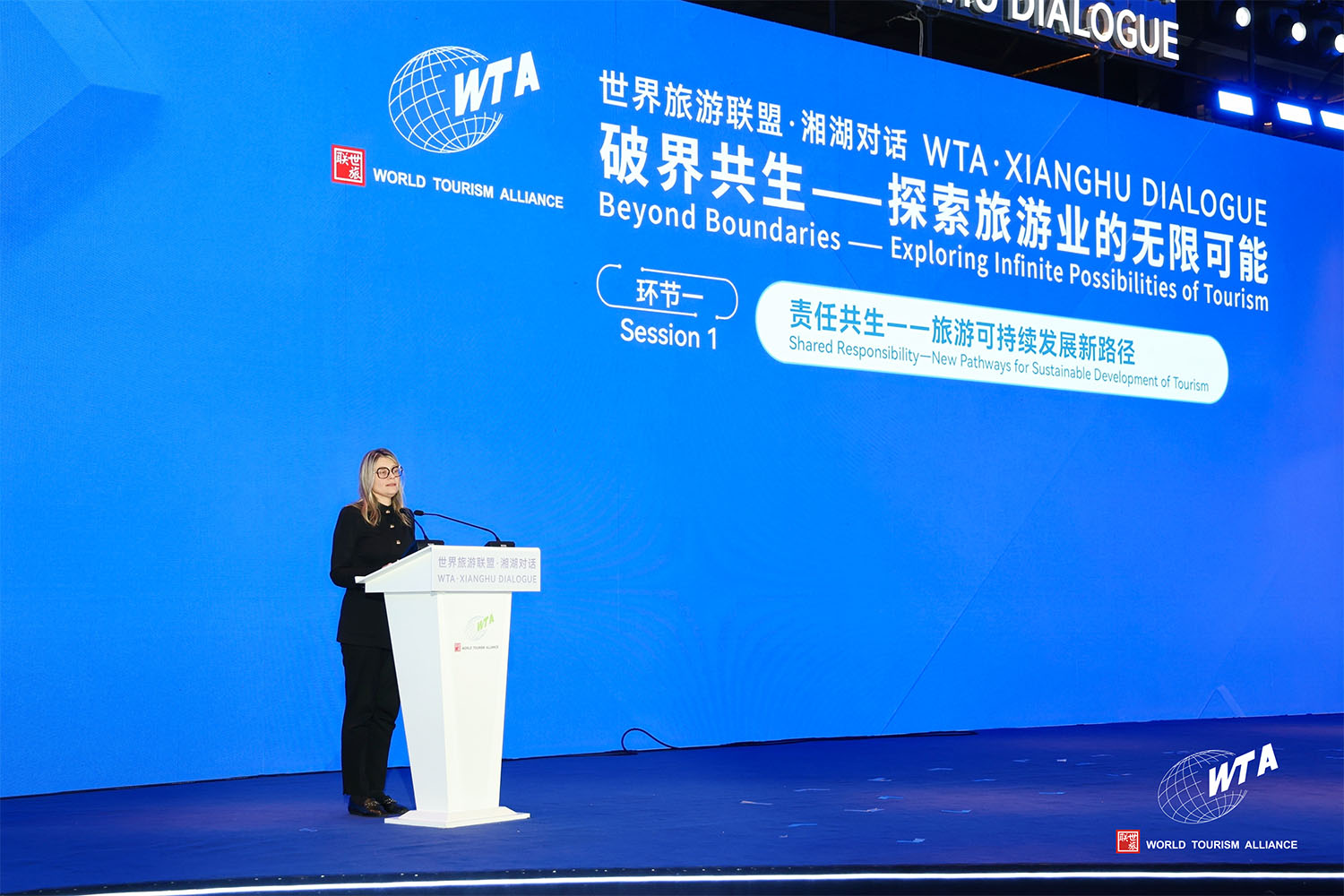
At this international event, I would like to reaffirm Italy’s commitment: We will continue to work hand in hand with all parties, sharing best practices, learning from each other’s innovations, and advancing cross-border cooperative projects. The collective future of global tourism depends on the effectiveness of our cooperation, the determination to integrate sustainability into decision-making, and our responsibility to future generations. I am confident that if we work together, we can create a more prosperous and beautiful future for the tourism industry.