


2025-12-09
The "2025 WTA • Xianghu Dialogue" was recently held in Hangzhou, China. The guests engaged in in-depth discussions on the theme "The Digital Transformation Path of Tourism Enterprises".
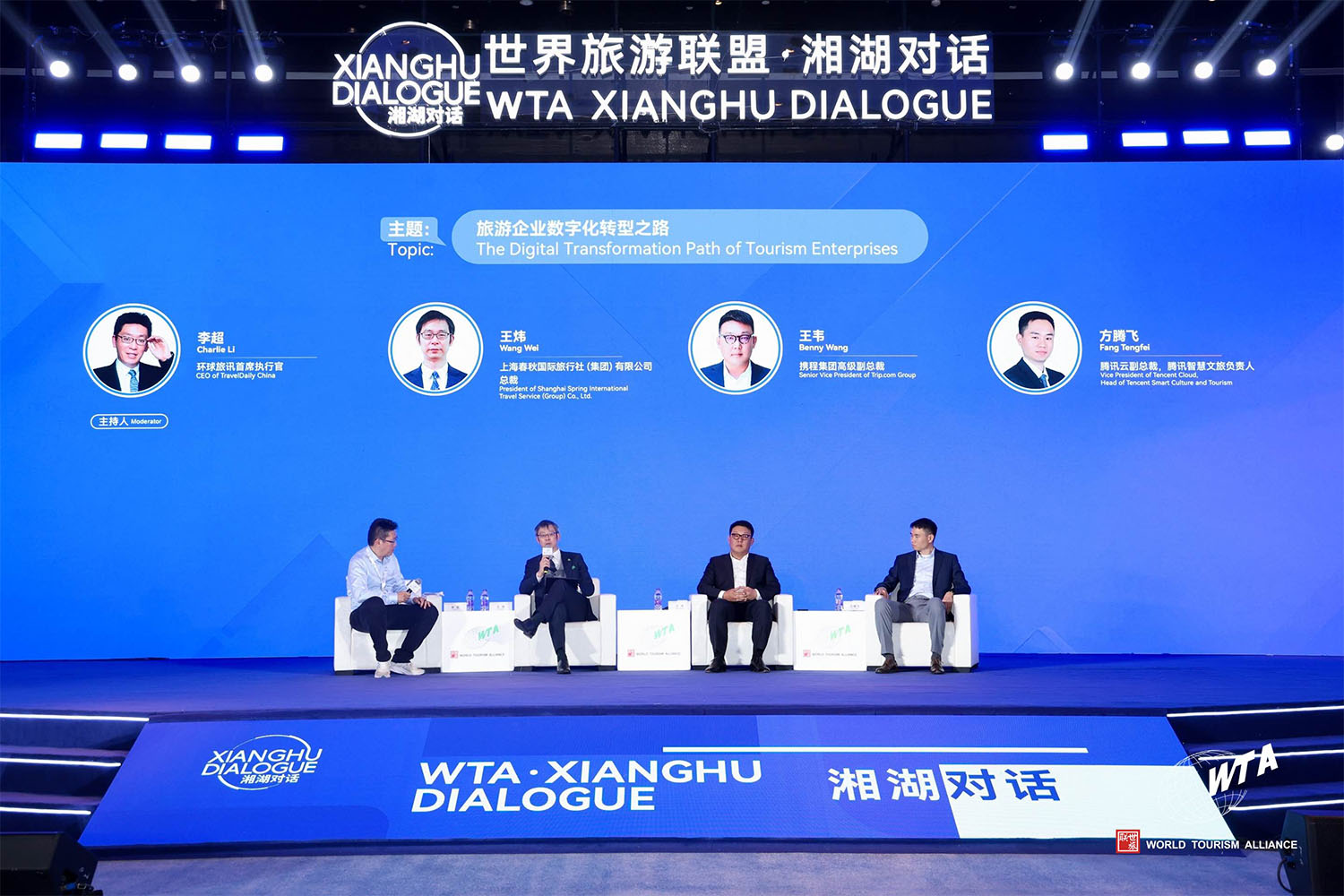
Moderator: Mr. Charlie Li, CEO of TravelDaily China
Panelists:
Mr. WANG Wei, President of Shanghai Spring International Travel Service (Group) Co., Ltd.
Mr. Benny WANG, Senior VP of Trip.com Group
Mr. FANG Tengfei, Vice President of Tencent Cloud, Head of Tencent Smart Culture and Tourism
Here is a transcript of the discussion:

Moderator: In the tourism industry, digital transformation has transcended being merely an optional competitive advantage; it has now become an imperative for the survival and growth of enterprises. What, then, are the core objectives driving this transformation, and what tangible outcomes have been realized thus far?
有限公司总裁王炜.jpg)
Mr. WANG Wei: Shanghai Spring International Travel Service embarked on its digital transformation journey in the 1990s, and today, digitalization has become an imperative pillar of our company. We have concentrated our efforts on two primary areas:
(1) Launching the "Smart Concierge" robot, which provides 24/7 interaction with travelers. Within just six months, this platform generated 200,000 product inquiries and facilitated sales of approximately 20 million RMB. (2) Empowering traditional product design. Previously, a product planner needed over an hour to launch a new offering. Now, with the support of our AI assistant, the same process takes just 15 to 20 minutes, significantly boosting operational efficiency.

Mr. Benny WANG: Since its founding in 1999, Trip.com has been deeply committed to digital innovation. Currently, we are leveraging AI to enhance efficiency across three major domains: (1) Operational Efficiency: Our technology team has improved development productivity by over 100% using AI programming tools. Tasks that once required an entire team can now be managed by a single programmer. (2) User Decision-Making Efficiency: As tourism products become increasingly complex, we leverage algorithms to precisely match user needs within a limited "inventory", ensuring that different customer segments can find the most suitable options. (3) Marketing Innovation Efficiency: In the past, a 100-person team could execute only 10 to 20 marketing campaigns per year. Today, through data-driven algorithms, our platform generates tens of thousands of dynamic recommendation lists daily, achieving truly personalized engagement at scale, with "a thousand faces for a thousand people".

Mr. FANG Tengfei: The cultural and tourism sector is currently undergoing a three-phase transformation: from "informatization" to "digitalization", and ultimately to "intelligent digitalization". AI is breaking through what were once considered insurmountable industry challenges by simultaneously achieving the "impossible triangle" of large-scale service delivery, personalized experiences, and low-cost operations.
For this industry, technological transformation presents both a challenge and an opportunity. Customized tours, once considered an exclusive high-end service, are now becoming accessible to the general public at a low cost through AI. For instance, Tencent, with its ecosystem of over 100 active products, leverages tools like the "QuickingData" to provide tourism enterprises with capabilities in audience profiling, customer insights, and precision marketing support.
Moderator: Data is the foundational asset for the tourism industry’s transformation in the AI era. How can tourism enterprises break down data barriers across various operational segments to better serve both their customers and ecosystem partners?
Mr. WANG Wei: Tourism is merely the medium; the core of the product lies in meeting travelers’ genuine needs. We are realizing this through "Human-AI collaboration": standardized, streamlined products are handled by machines, while personalized services with a "human touch" are led by people. However, to achieve efficient human-AI collaboration, the key is to break down data barriers.
Within our organization, we face numerous data-related challenges: customer identity tags are inconsistent, and the data dimensions between wholesale and retail operations are fragmented. Wholesale focuses on suppliers, while retail focuses on end-users (C-end). This results in massive amounts of data requiring repeated cleaning and restructuring, creating a significant workload. We are addressing this by unifying data definitions and enforcing data cleansing and integration to foster internal system synergy.
Mr. Benny WANG: Since 2010, the tourism consumption market has undergone profound changes, with user demands becoming increasingly complex and diverse. Traditional "guide-led" group tours are gradually declining, while "social loop-based" small group tours are on the rise, emphasizing autonomy and customization. This shift poses a significant challenge to traditional brick-and-mortar stores. Trip.com has adopted a strategy of "Technology + Standards + Talent" to assist offline stores in adapting to the new consumption era.
We harness technology to unlock global inventory and address resource bottlenecks. Our talent development programs are integrated with online resources to enhance service capabilities. Additionally, we utilize community-based stores to enable direct interaction with senior customers, creating complementary service experiences.
Mr. FANG Tengfei: In the era of intelligent digitalization, truly valuable data assets must meet three criteria: high quality, large scale, and real-time accessibility. Fragmented, static, and noisy "dead data" cannot power intelligent decision-making. Only "live data" — continuously integrated in real-time with core business systems — can achieve this.
The explosion of AI has turned digitalization from a competitive "bonus" into an existential "necessity". In the past, lagging in digitalization might have set you back 20 points; now, failing to adopt AI could bring a company to a complete standstill. Our "QuickingData" can provide cultural and tourism enterprises with over 130 dimensions of audience profiling. These insights can guide precise store location selection, targeted advertising, and personalized customer marketing, enabling businesses to operate with much greater accuracy.
Moderator: The younger generation of consumers, having grown up in the digital age, readily embraces digital services like AI-driven itinerary planning, smart customer service, and AI-guided tours. What key shifts have occurred in their travel demands, and how should tourism companies respond?
Mr. WANG Wei: Based on our current data, several key trends are evident:
(1) Female Travelers Outnumber Males. Women now constitute a much larger proportion of travelers than men and play a dominant role in family and couple travel decisions. In response, we launched the internal "Four Libraries" project, which includes: the "Resource Library" for integrating destination products; the "User Library" for profiling customer segments; the "Talent Library" for supporting service innovation; and the "Demand Library" for identifying latent consumer needs.
(2) A Crisis of Trust Due to Information Overload: The heavy "filters" on platform content have led to rising user skepticism. We are currently conducting a grey-box test for a new product, "Travel Detective", inviting young users to verify the authenticity of travel content on-site.
(3) A "Spindle-Shaped" Consumption Pattern: The main consumer base is shifting. Young consumers now have stronger spending power, often supported by older family members, while the 55-75 age group is typically financially secure, retired, and highly digitally literate. Therefore, a core task for AI is to help users distinguish truth from misinformation and accurately match real needs with genuine offerings.
Mr. FANG Tengfei: Today’s travel behavior is shifting from a functional to an experiential focus. The demands of the younger generation can be categorized into three ascending levels:
Travel decisions often begin with a mood — an impulsive urge sparked perhaps by a captivating video on social media. This initial impulse then evolves into a search for context, where travelers seek more than a mere "checking in"; they desire an environment that enables truly immersive experiences. Ultimately, the journey culminates in emotional fulfillment, serving as both a form of self-expression and a response to deeper inner needs. This progression — from mood, to context, to emotion — calls for product design that draws on nuanced data insights. Only by truly understanding the traveler’s emotional journey can we create experiences that resonate at a deeper level.
Moderator: At its core, tourism is based on service operations. How can travel companies better balance their investment in AI and human resources?
Mr. Benny WANG: AI enhances efficiency not through simple workforce reduction but through the structural optimization of human roles. For instance, while the headcount in our customer service call center today is similar to that of 2006, technology has freed up a significant portion of manpower for higher-value tasks. Technological iteration drives industry progress, and it is too early to conclude whether humans will ever be fully replaced. Trip.com will continue to introduce new technologies, optimize algorithms, and explore more transparent service models to better align business rules with evolving user needs.
Mr. FANG Tengfei: "Warmth" represents the highest form of service, yet currently, most tourism services still primarily meet functional needs. Small and medium-sized enterprises have already begun using AI to replace simple, repetitive human jobs, leading to a reshaping of job structures driven by technological advancement. In the future, in the era of the "personal AI agent", AI may understand an individual better than their partner does. I firmly believe that the impact of technology on tourism will be disruptive, and industry players should actively embrace it, not resist it.